Yoghy Organics
Yoghy Organics Pure Botanical Tisanes & Ratio Engine
Botanical Pharmacopoeia & Brewing Desk

Pure Organic Botanical Tisanes & Ratio Engine

Mathematically calibrated dry botanical mass in grams, kitchen volumetric measures, water temperatures, and infusion times for whole dried flowers, roots, and spiced barks.

Herbalist Formulations:
Dosage: 2.0g
Water: 205°F
Steep: 5.0 min
4 oz (120ml) 8 fl oz 64 oz (1890ml)
Calculated Dry Botanical Mass Covered Infusion
2.0g
Kitchen Measure: ~1.9 tsp (~6 whole flowers)
Water Temperature
205°F / 96°C
Optimal extraction threshold
Optimal Duration
5.0 min (300s)
Prevents tannin bitterness
Cumulative Yield:
Up to 24 fl oz (2 re-steeps)
Steep Timer Ready 05:00
Phytochemical Chromatic Indicator

Anthocyanin pH Transformation

Ternatin polyacylated anthocyanins shift from sapphire blue to magenta as acidity increases.

Deep Sapphire Blue
pH 7.2
Alkaline / Neutral Acidic Citrus
pH 7.8 pH 6.0 pH 4.5 pH 2.8
Biochemical Mechanism: Delphinidin-3,3',5'-triglucoside aglycone undergoes reversible structural ionization in the presence of citric and ascorbic acids, modifying light absorption wavelengths between 550nm and 620nm.
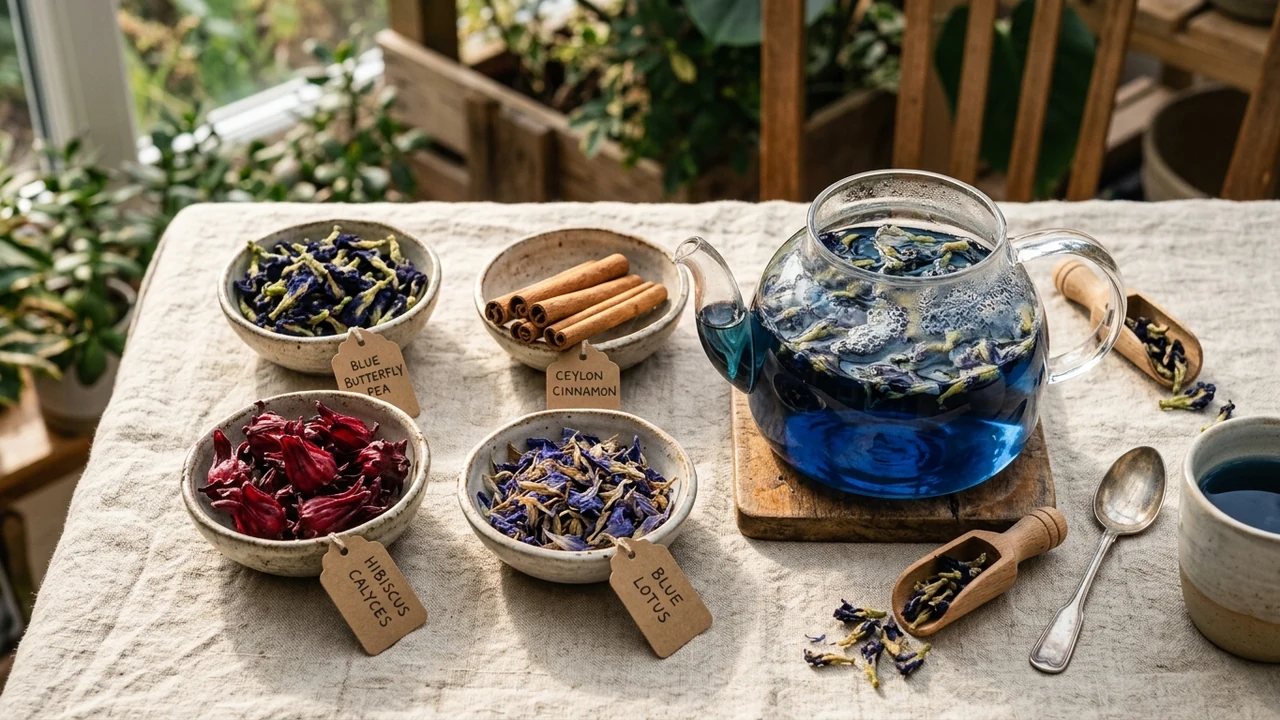
Artisanal organic botanical apothecary flatlay with sun-dried butterfly pea, Ceylon cinnamon quills, ruby hibiscus calyces, and steeping sapphire tea
Botanical Harvest
Primary Focus: Single-Origin Tisanes 10 Verified Botanicals

Universal Botanical Infusion & Herbal Dosage Ratio Engine

Yoghy Organics is the definitive evidence-based botanical tisane authority and brewing ratio engine. Herbal enthusiasts and home apothecaries calculate precise dry mass in grams, kitchen volumetric measures, water temperatures, and infusion times for whole dried flowers, roots, and spiced barks with zero bitterness or degradation.

Preparing botanical tisanes is an exact science of thermal extraction kinetics and physical density. Unlike commercially pulverized tea fannings trapped in bleached paper teabags, authentic single-origin botanicals—from delicate sun-dried organic blue butterfly pea flower tea blossoms to multilayered quills of true Ceylon cinnamon tea bags—retain intact cellular structures.

When steeping whole botanical parts, water temperature determines whether you extract gentle bioflavonoids or harsh, mouth-drying astringency. Delicate floral alkaloids like aporphine in sacred organic Egyptian blue lotus flowers require gentle 195°F water, whereas dense woody rhizomes like warming dried ginger root tisane require active boiling decoction at 212°F to liberate warming gingerols.

The 6 Core Botanical Silos: Florals, Spiced Barks, Roots & Camellia

Explore our curated single-origin herbal collections, each organized by botanical family, active phytochemistry, and therapeutic synergy:

Cortex Tisanes

Ceylon Cinnamon

Low-coumarin Cinnamomum verum quills, sweet woody fragrance, metabolic support.

Explore Cinnamon Silo →
Calyx Infusions

Ruby Hibiscus

Cut & sifted Hibiscus sabdariffa calyces, rich in anthocyanins and tart vitamin C.

Explore Hibiscus Silo →
Rhizome Decoctions

Digestive Ginger

Sun-dried Zingiber officinale roots, pungent warming thermal kick for digestion.

Explore Ginger Silo →
Floral Blossoms

Chamomile Blossom

Whole golden Matricaria chamomilla flower heads rich in calming chamazulene.

Explore Chamomile Silo →
Apothecary Index

Brand Collection

Complete apothecary catalog of rare botanical herbs, wildcrafted tisanes, and lab purity tests.

View Full Catalog →
Botanical Monograph

Kalanchoe Life Leaf

Traditional Bryophyllum pinnatum miracle leaf guide for immune balance and cellular vitality.

Read Herbalist Guide →

Why Traditional Steeping Fails: The Teaspoon Trap & Thermal Degradation

For over a century, commercial tea packaging has relied on the vague recommendation to "add one rounded teaspoon per cup." In modern culinary phytotherapy, this is known as the Volumetric Density Trap.

When you scoop one level teaspoon of whole dried Blue Butterfly Pea flowers, you are introducing approximately 0.35 grams of botanical leaf matter. In an 8-ounce cup of water, this produces an anemic, watery brew devoid of therapeutic ternatins. You actually need ~1.9 teaspoons (or 5–7 whole blossoms, representing 2.0g) for proper extraction.

Conversely, scooping one rounded teaspoon of dense crushed Ceylon cinnamon quill fragments yields over 2.6 grams of bark. If you steep that same quantity in an 8-ounce cup with boiling water, you risk over-saturating the solvent and extracting harsh tannins. Our interactive engine eliminates this guesswork by translating precise scientific dry mass into calibrated kitchen measures.

Anthocyanin pH Color Transformation & Extraction Thermodynamics

Certain botanicals—most notably Clitoria ternatea (Butterfly Pea) and Hibiscus sabdariffa—function as natural chromatic pH indicators. Their vibrant pigmentation arises from complex polyacylated anthocyanins that undergo reversible molecular conformation shifts in response to hydrogen ion concentration.

At neutral tap water conditions (pH 7.0–7.4), the anthocyanin molecules absorb wavelengths in the yellow-red spectrum, causing the liquor to glow with a deep, mesmerizing sapphire blue. When acidic elements such as lemon juice, lime wedges, or tart hibiscus are introduced, the solution's pH drops below 5.0. This protonates the flavylium core, shifting light absorption to 550nm and transforming the color to regal amethyst purple and vivid magenta.

Frequently Asked Questions About Organic Botanical Teas

01 Why does measuring herbal tea with a kitchen teaspoon cause inconsistent brews?

Whole dried botanicals have drastically differing bulk densities. Fluffy whole flowers like Blue Butterfly Pea have a density of just 0.35 g/tsp, requiring nearly two teaspoons to reach a standard 2.0g single-cup dosage. Conversely, crushed barks like Ceylon Cinnamon have a density of 2.60 g/tsp. Using a teaspoon measurement blindly results in either watery under-extracted tea or unpleasantly bitter over-extraction.

02 What is the biochemical cause of Blue Butterfly Pea tea's color transformation?

Blue Butterfly Pea flower contains concentrated ternatin anthocyanins (specifically delphinidin glycosides). In neutral filtered water (pH 7.0–7.4), the anthocyanin molecules maintain a planar quinonoidal base conformation that absorbs red-yellow light, reflecting deep sapphire indigo. Adding an acid like lemon juice or lemongrass lowers the pH below 5.0, protonating the flavylium cation and triggering an instantaneous chromatic shift to vivid amethyst and bright magenta.

03 What is the difference between a covered hot infusion and an active simmer decoction?

Covered infusions steep delicate plant parts (flowers, leaves) in freshly boiled water that has cooled slightly (175°F–205°F) with a lid on to prevent volatile essential oils and terpene aromatics from evaporating. Active simmer decoctions submerge dense, fibrous plant parts (woody barks, roots, hard seeds) in boiling water (212°F) maintained at a gentle stovetop simmer for 10 to 15 minutes to crack cell walls and extract deep polyphenols like cinnamaldehyde and gingerols.

04 Why is true Ceylon cinnamon safer for daily tea drinking than supermarket Cassia?

Supermarket cinnamon is almost exclusively Cassia (Cinnamomum cassia), which contains dangerous levels of coumarin (up to 1.0%), a phytochemical known to cause liver toxicity with regular consumption. True Ceylon Cinnamon (Cinnamomum verum) contains less than 0.004% coumarin, making it safe for daily therapeutic sipping and extended simmering.